AI agent employees that do real work. Not chatbots.
SYRV AI builds, deploys, and operates a governed digital workforce inside your own tenant, on the technology you already run: executive agents in your leaders’ inboxes, operational agents in your workflows. You buy capacity you can count in labor-equivalent terms, reported on your P&L every week. Humans approve what matters. Nothing acts unaudited.
- Who runs itSYRV AI builds, deploys, and operates it
- Where it runsYour tenant, under your own identity and security controls
- How it actsDraft-and-approve. A human approves what matters.
- How it is measuredLabor-equivalent capacity, reported weekly
Assistants answer. Agents do the work. We operate the workforce.
An assistant answers a question and a person still does the work. An agent employee owns the work: it detects, diagnoses, drafts, and escalates, and a person approves what matters. The gap between the two is not the model. It is governance your IT can verify, and an operator who runs the workforce every day. That is what SYRV AI supplies.
Generative copilots that answer questions and draft content. Helpful, but a person still does the work.
Single AI agents that complete whole tasks, such as research, reconciliation, and reporting, under supervision.
Orchestrated agent teams that run end-to-end workflows, coordinating, monitoring, and enforcing rules, with humans approving what matters.
The next advantage is not using AI. It is operating a governed agent workforce, safely, first.
Two families of agent employees. One governed workforce.
Designed around the jobs your leadership needs done, built into your tenant, and operated by SYRV AI as one workforce: one approval queue, one audit trail, one weekly value report. Each agent below is a worked example from a deployed fleet, not a category.
Executive agents
Force multipliers for your leaders
Drafts your email and documents
In your voice, ready to review and send. Never sent without you.
Preps your meetings
Agendas, context, and the documents you will actually need.
Briefs you every morning
Calendar, priorities, and what needs your attention today.
Reads and summarizes
Files, threads, and meeting recaps, with owners and timelines. Judgment stays human: the agent proposes, the person approves.
Operational agents
A workforce for your workflows
Coordinators
Own recurring processes end to end, keeping production, BOM, packaging, and rework moving. They draft, never auto-commit.
Monitors
Watch your data around the clock and flag the quality hold, the shortage, or the at-risk deadline before it is a crisis. Read-only.
Liaisons
Bridge teams and systems, handling the supplier and customer back-and-forth and routing what needs a decision.
Rule-keepers
Enforce your playbook consistently, so it no longer only works when one person is in.
- Detect
- Diagnose
- Recommend
- Approve
- Execute
- Learn
Approve is always a human.
Codified tribal knowledge is the unlock. At one manufacturer we analyzed 130 meetings and about 620,000 words to capture roughly 250 of the business rules that ran the operation, then designed the agent workforce around them. The knowledge that used to walk out the door at 5 p.m. now runs as governed agents in your tenant.
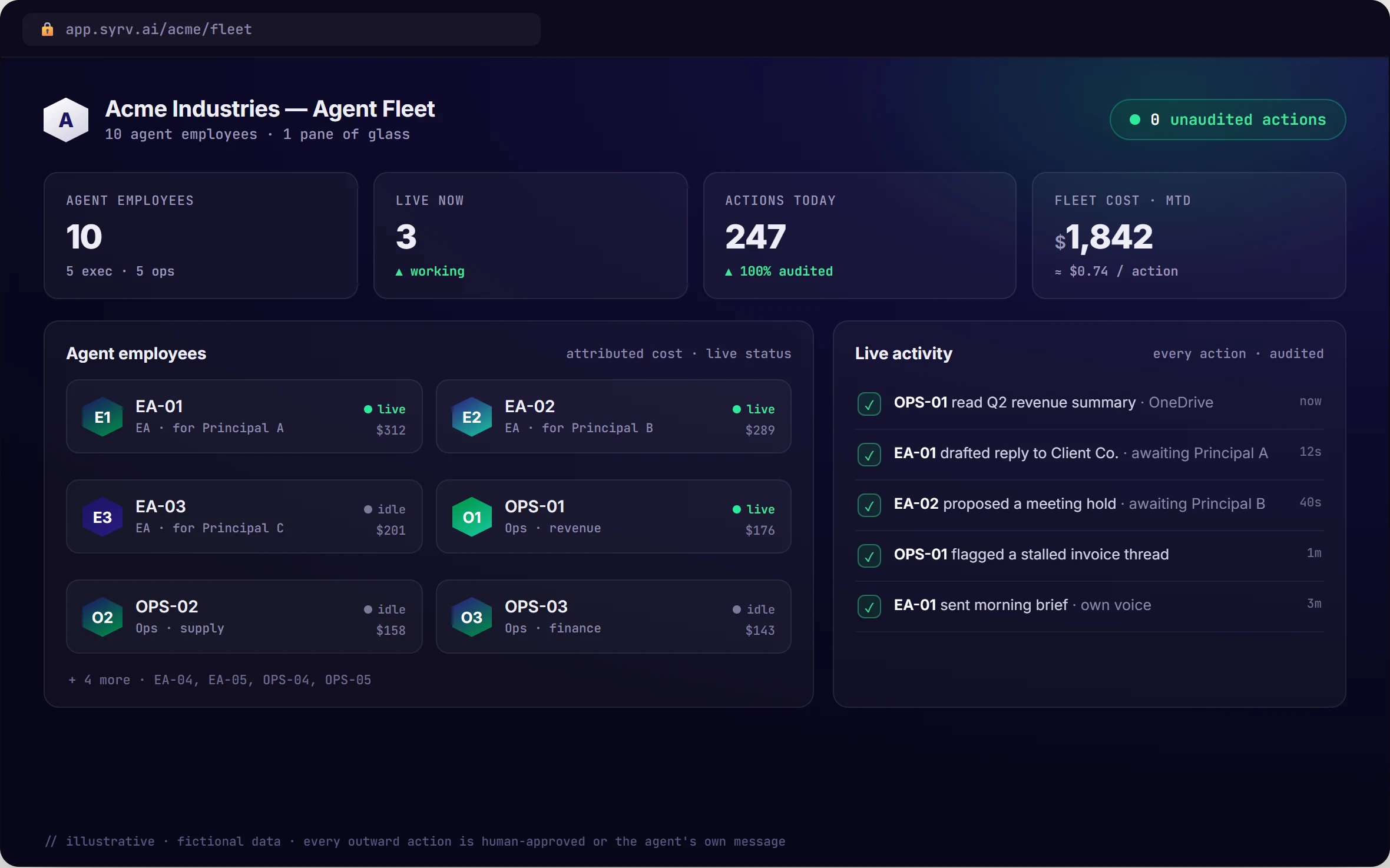
One pane of glass for the whole fleet
Executive and operational agents side by side, with attributed cost, live audited activity, and the counter that never moves: zero unaudited actions.
SHIPPED SURFACE · STYLIZED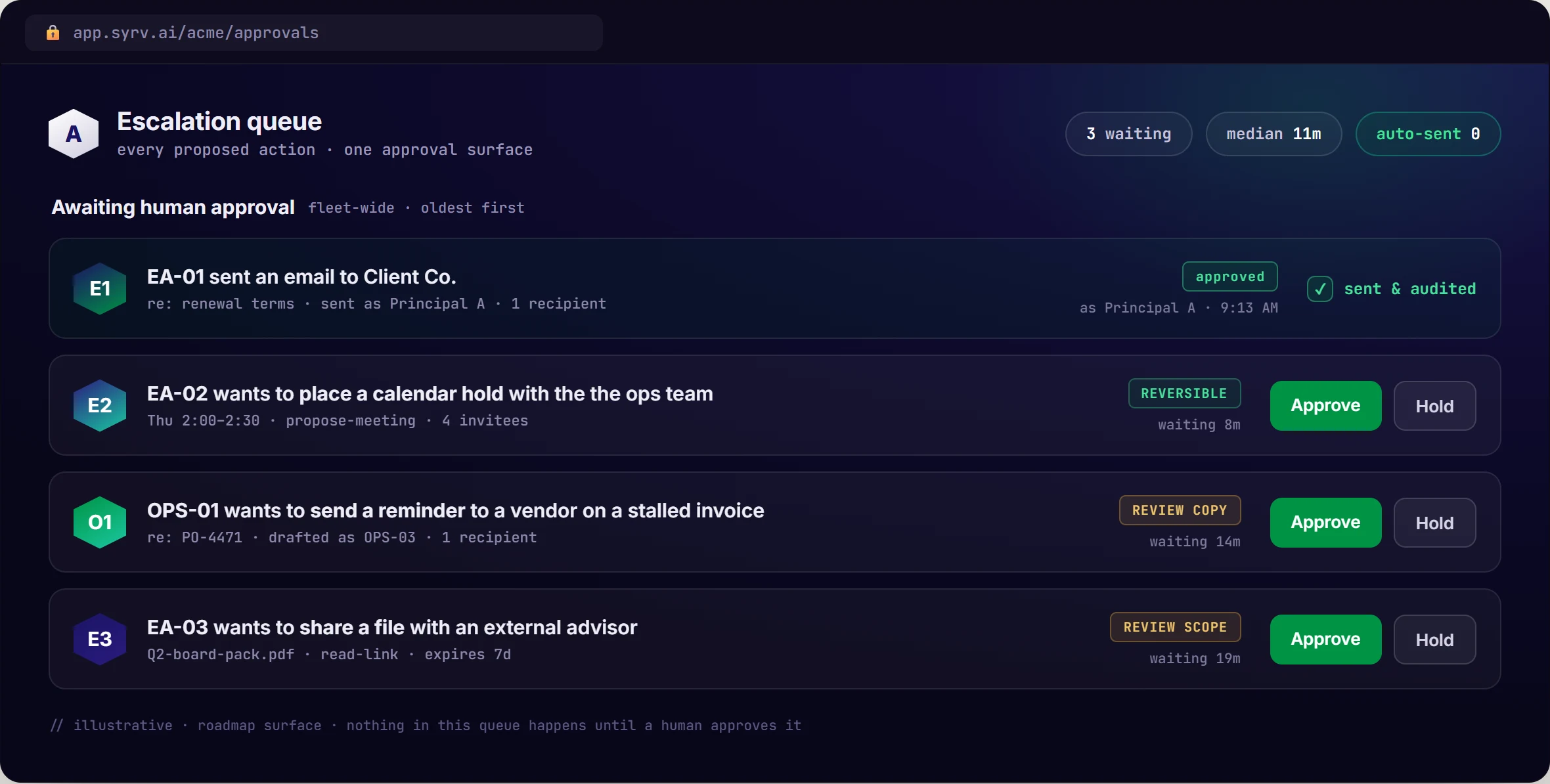
One approval queue
Every proposed action across the fleet lands in one queue, drafted, scoped, and waiting. The agents think freely; the outside world only changes when a person approves.
ROADMAP SURFACE · PHASE 3What one agent pod is worth: capacity created against run cost.
We price and report in the same unit: labor-equivalent capacity, set against what the pod costs to run. An illustrative base case, not a measured result from any client.
The model counts only labor-equivalent value, before fewer emergencies, less schedule churn, and faster decision cycles. Your numbers are set with you, on your KPIs, before an engagement starts, and reported weekly after. If it cannot be measured, it is not proposed.
Illustrative model · assumptions shown · actual results vary by deployment
| Agents per pod | 5 |
|---|---|
| Total pod run cost, annual | $50,000 |
| Capacity created (conservative) | 3.0 FTE-equivalent |
| Human-cost value of that capacity | $420,000 |
| Net annual advantage per pod | $370,000 |
| Value ÷ run cost | 8.4× |
Everything runs in your tenant. Nothing acts without you.
Draft-and-approve is a deliberate design choice, and it is the reason your IT can say yes. Agents think freely; the outside world changes only when a person approves. The rest of the trust case is architecture your security team can verify before anything goes live: your tenant, your Entra identities, least privilege, and a complete audit trail.
Draft-and-approve, by design
- Agents read, think, and draft freely, then wait for a person to approve any action. This is the trust feature, not a limitation we will remove.
- One approval queue across the whole workforce. High-impact actions never execute alone.
- Operational agents enforce your rules and escalate. They never change a system’s state on their own.
In your tenant, not ours
- Every agent runs inside your own environment. Your data never moves to ours.
- Each agent runs under its own managed identity, scoped to only the secrets it needs.
- Secrets live in your own Azure Key Vault and are rotated. Never in code, images, or environment variables.
Entra Agent IDs and least privilege
- Every agent carries an Entra Agent ID, the same controls you use for your people. No black box.
- Least-privilege, delegated access per person via Microsoft’s own OAuth consent. Agents reach only what you grant.
- Conditional Access, MFA, and your tenant policies apply to agents exactly as they apply to staff.
Fully auditable
- One-page action surface: your IT reads exactly what every agent is allowed to do.
- Every approved action is executed, logged, and replayable in your own audit trail (Application Insights and Log Analytics). Zero unaudited actions.
- A weekly report shows what each agent did and the value it delivered.
Your models, your terms
- Model-agnostic frontier models on enterprise terms. Your data is never used to train anyone’s model.
- We build, run, and report weekly. Your data never moves to SYRV AI.
- Designed to align with NIST AI RMF and ISO/IEC 42001. Compliance answered by architecture, not policy decks.
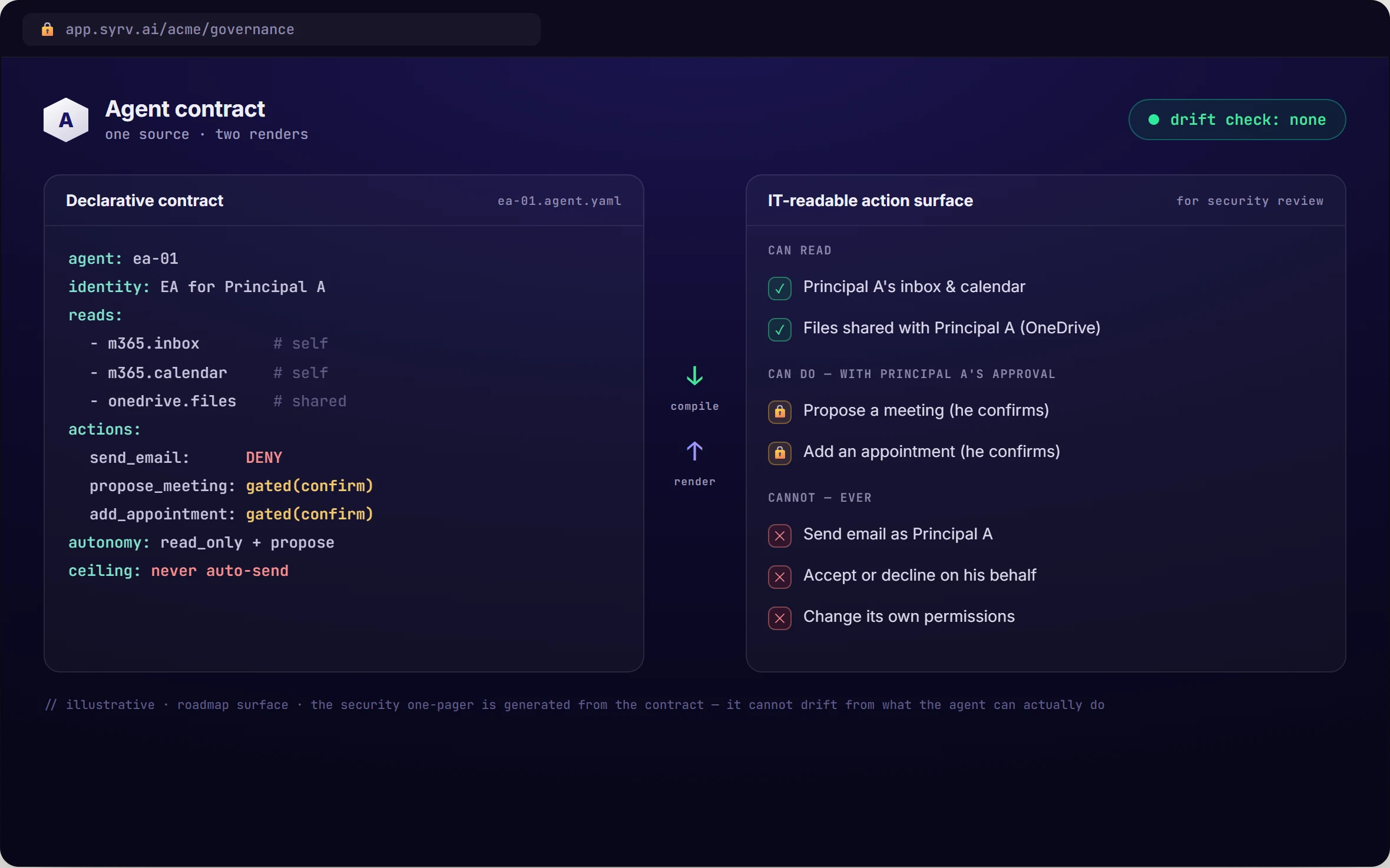
The agent contract, in two languages
The declarative contract the agent runs on, compiled into a plain-language action surface your IT team can read, with a continuous drift check proving the two never disagree.
ROADMAP SURFACE · PHASE 2Replay any action
Reads, drafts, scheduled runs, escalations, and approvals on one axis, and any event expands into the exact chain of context that produced it. Audit you can watch, not just download.
ROADMAP SURFACE · PHASE 3We build it. We run it. You see the value weekly.
A named method, the five C’s, turns the tacit knowledge in your people’s heads into a digital labor force that compounds: mapped, codified, built, cut over, and improved every quarter. Inside every phase the cadence is build, test, learn, expand, with KPI baselines set before we start, a weekly value report measured on your P&L after, and a decision gate before anything scales. You buy work done, not seats or project hours.
- 01
Cartograph
Map how work actually happens, the workflows, decisions, and tacit knowledge, into an Enterprise Intelligence Atlas.
- 02
Codify
Convert tacit knowledge into decision logic, training corpora, evals, and guardrails your agents obey.
- 03
Construct
Build the production agent stack: governed, observable, in your tenant. Not a proof of concept.
- 04
Cutover
Adoption, role redesign, change orchestration. Most of the engagement effort lives here, by design.
- 05
Compound
The workforce compounds: agents retrain, rules sharpen, new workflows join, and every quarter outperforms the last.
The weekly value report
Hours reclaimed against forecast, exceptions caught before they landed, draft acceptance, key-person roles de-risked. The artifact the renewal conversation is built on.
SHIPPED SURFACE · STYLIZEDWe invest in IP, so your engagement starts ahead.
Agent Factory and accelerators
A governed system for building, testing, deploying, and monitoring agents, plus reusable agent libraries and document pipelines. An engagement does not start from zero.
Decision Logic Library
Your tacit knowledge, how decisions actually get made, codified into rules, training corpora, evals, and guardrails. An enterprise asset you keep.
Two owned products
The AI Agents Platform, live and in daily production at an enterprise-scale manufacturer, and OncologyKOL, a patented venture-scale platform. We productize what services teach.
Six U.S. patent filings
133 claims over agentic methods: policy-constrained agent communication, recipient-centric outreach control, closed-loop engagement, and influence-graph simulation.
Cutting-edge, without the hype: if it can’t be measured, it isn’t proposed.
Every alternative sells something real. None of them sells and runs the work.
Position: secure, governed AI agent employees in high-value workflows, operated by senior AI leaders. We sell and run the work, not just the software.
| The alternative | What you are buying | What SYRV AI sells and runs |
|---|---|---|
| Pure SaaS product | The instrument. You integrate it, govern it, staff it, and run it yourself. | The work: agent employees built for your workflows, run for you, measured weekly on labor-equivalent value |
| Big-4 or large systems integrator | Senior names in the pitch, a large delivery team behind them, and a plan as the deliverable | Senior operators design, build, and run the workforce themselves |
| Hyperscaler or platform vendor | Infrastructure, models, and seats. The last mile, governance, and adoption are left to you. | The last mile is the product: governed agents in your tenant, doing the work, on your P&L |
| Prompt or point-tool shop | A demo and a prompt. Nobody governing or operating it next quarter. | Governance by architecture, a weekly value report, and an operator who runs it every week |
| Full-time CAIO hire | A long search, and no delivery team or workforce on arrival | Fractional CAIO with the team and the agent workforce included, day one |
In a line: governed AI agent employees that do the work, in your tenant, measured on your P&L, run by senior operators.
A $1.8B food manufacturer runs on an agent workforce.
A multi-plant poultry processor put SYRV AI agent employees in front of its CEO and operations leadership, in daily use across about 18 working capabilities. A 15-agent fleet in three governed classes: orchestrators draft and never auto-commit, monitors are read-only, synthesizers are scope-isolated. We then went deeper, mapping a four-plant production operation, an always-on hedge decision engine for meat procurement, and an AI consumer-care line that escalates food-safety issues. The CEO now introduces the work to peer CEOs in his network, unprompted. Advocacy is the metric that matters.
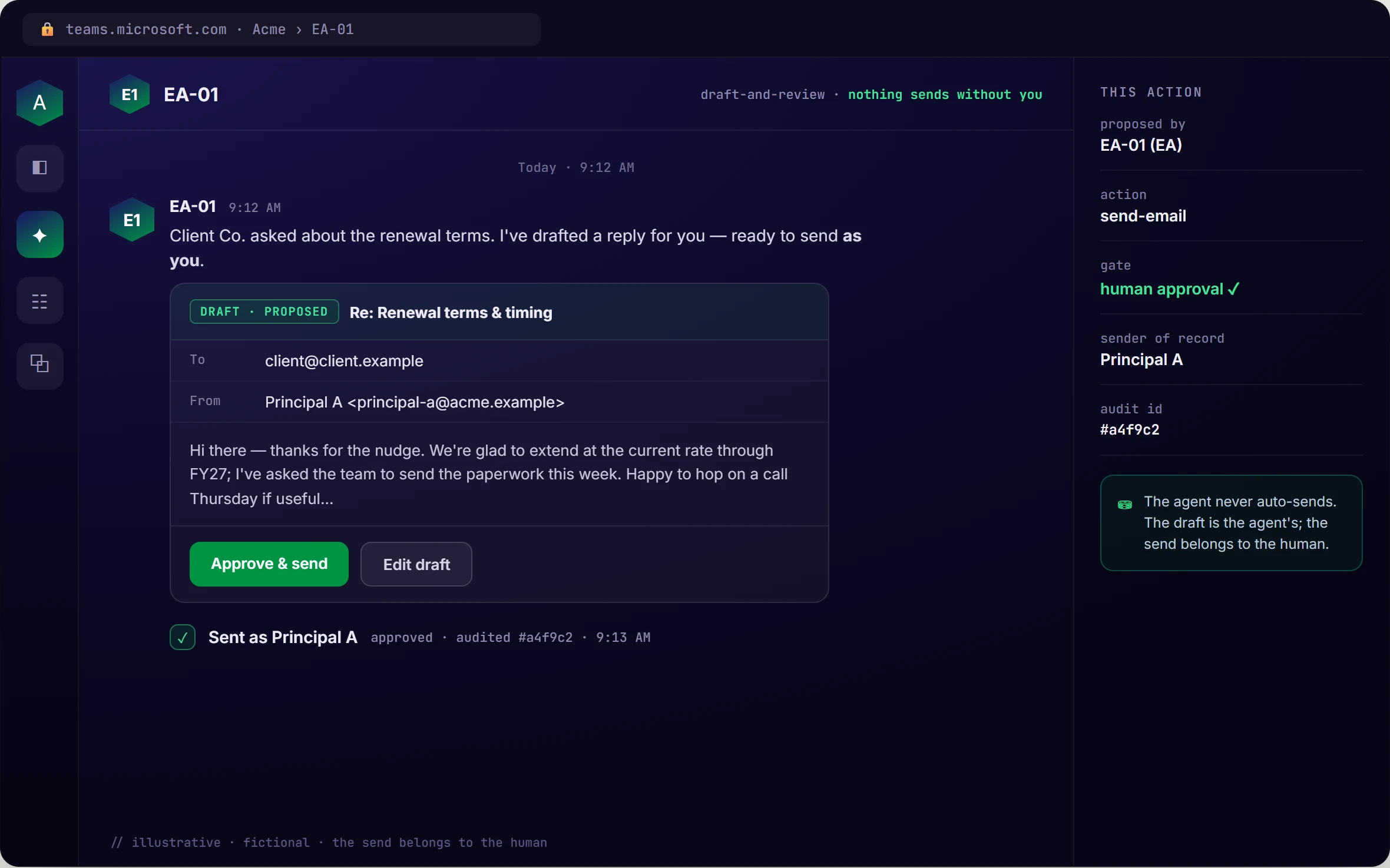
Approve where leaders already work
The agent proposes a finished draft inside the tools your executives live in, the human approves, and the send belongs to the person. Every time, audited.
SHIPPED SURFACE · STYLIZEDStraight answers.
Do we need to replace Copilot?
Where does it run?
Will it send emails as me?
Can our IT control what it does?
Do we need an in-house AI team?
When do we see value?
How is value measured?
Is this consulting or software?
Available in
Cincinnati & Northern Kentucky
Our team is ready to help with your ai agents platform needs in the Greater Cincinnati area.
Related Services & Solutions
ElsewhereWhich work would you hand to agent employees first?
Tell us how your operation runs. We will map the agent employees that would matter most, what it takes to stand them up in your tenant, and how we would run and measure them for you.